
Turnstiles do more than keep tenants honest. They deliver a measurable return on investment (ROI) for the organizations they serve — often paying for themselves in as little as one year. By matching entrance control to your operational needs, you unlock benefits that go well beyond peace of mind: turnstiles save money, earn money back, and keep doing both for millions of cycles.
Here's how the math works in your favor.
What Is the ROI of Turnstiles?
Turnstile ROI comes from four places: improved operational efficiency, reduced labor costs, elimination of theft and system abuse, and avoidance of security incidents. Together, these savings frequently outpace the upfront investment within the first few years of deployment — and in high-traffic environments like university dining halls, payback can arrive in roughly one year.
How Do Turnstiles Improve Operational Efficiency?
From small businesses to large corporations, operational efficiency means minimizing waste, reducing resource consumption, and optimizing productivity. For facilities like hospitals, data centers, and government buildings, efficient crowd management keeps traffic flowing and operations running smoothly.
Your entrance sets the tone for the entire visitor experience. Long lines and delays don't just frustrate people — they deter them from proceeding with business at all.
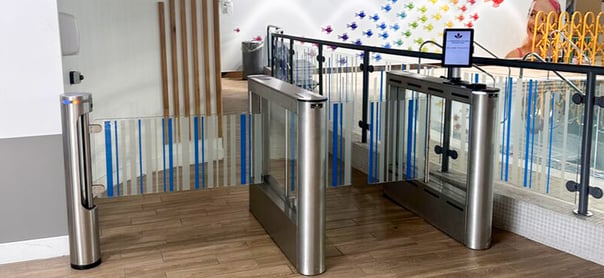
Optical turnstiles streamline passage with fast, accurate entry decisions. Instead of waiting on a manual checkpoint, authorized users move through at speed — Fastlane turnstiles from Smarter Security can process up to 60 people per minute per lane. No bottlenecks, no guesswork, no holdups.
How Do Turnstiles Reduce Labor Costs?
Manual check-in points are expensive. They require staffed posts, and human clearance is vulnerable to delays and social engineering tactics — a friendly smile and a confident walk can get past a distracted guard, but not past a sensor array.
By automating entry verification, turnstiles let businesses consolidate staffing and allocate human resources where they add the most value. The hourly wages that would otherwise pile up at manned checkpoints go straight back into the budget. For facilities running multiple entrances across multiple shifts, those labor savings compound quickly.
How Do Turnstiles Stop Theft and System Abuse?
Eliminating system abuse is a top priority for organizations — and it's where turnstile ROI shows up as actual earnings, not just savings.
Equipped with tailgate detection and the ability to enforce your access protocols, turnstiles defend against the kind of credential-sharing and piggybacking that quietly drains revenue. When every entry requires a valid credential, businesses increase profit through correct credential sales — whether that's meal plans, memberships, or facility access. The return on investment grows on both sides of the ledger.
How Do Turnstiles Protect People, Assets, and Reputation?
At their core, turnstiles maintain safety and security for people, assets, and facilities alike. They significantly decrease the likelihood of disturbances or damage, sparing businesses the cost of incident resolution. The stakes are real: according to IBM's Cost of a Data Breach Report, roughly 10% of malicious data breaches involve a physical security compromise.
Depending on your needs, turnstiles can integrate with smart technology to expand access control capabilities — touchless sensors, biometric credentialing, role-based authentication, and more. These systems act as a barrier against unauthorized access, safeguarding critical data, mitigating costly legal exposure, and protecting your company's reputation. A strong security posture discourages bad actors before they ever attempt a breach.
 What Does Turnstile ROI Look Like in the Real World?
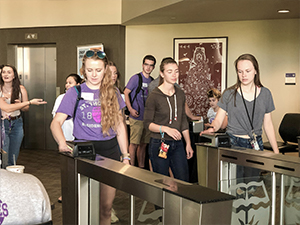
The University of St. Thomas put these principles to the test. As detailed in our case study, Fast-Track Dining: Touchless Turnstiles for Expedited Access, the campus was facing rising meal plan theft and excessively long dining hall lines — and needed a solution that was thorough and easy to maintain.
Implementing Fastlane turnstiles from Smarter Security with identity-specific credentialing in the dining halls cut wait times, increased profits through correct meal plan sales, and boosted both security and student satisfaction. Executive Director of Dining Services Steve Griffin applauded the results: "The technology felt high-tech and had a wow factor that impressed students and staff alike."
The numbers tell the story:
- 70% decrease in queuing
- 50% reduction in meal theft
As our turnstile expert and Midwest Region Sales Manager Amber Beckwith puts it: "Smarter Security turnstiles for higher education dining halls is a no brainer! The return on investment is phenomenal and often as quick as 1 year."
The Bottom Line on Turnstile ROI
Turnstiles are often associated with securing traffic, but their impact extends far beyond the entrance. Improved crowd management, enhanced security, labor optimization, theft reduction, and happier visitors all flow from one smart investment. For any establishment weighing the cost of entrance control, the question isn't whether turnstiles pay for themselves — it's how quickly.
Ready to run the numbers for your facility? Explore entrance control solutions for education and beyond, or contact our team to talk ROI.
Frequently Asked Questions About Turnstile ROI
How quickly do turnstiles pay for themselves?
Payback timelines vary by facility and traffic volume, but in high-throughput environments like university dining halls, the return on investment can be realized in as little as one year through reduced theft, labor savings, and increased credential revenue.
Do turnstiles really reduce labor costs?
Yes. Turnstiles automate entry verification, eliminating the need for staffed manual checkpoints. Organizations can reassign or reduce checkpoint staffing, cutting hourly labor expenses while improving entry accuracy.
How do turnstiles prevent tailgating?
Optical turnstiles use sensor arrays to detect when more than one person attempts to pass on a single credential. Fastlane turnstiles from Smarter Security can detect tailgating attempts with industry-leading precision, triggering alarms or denying passage before unauthorized entry occurs.
What facilities benefit most from turnstile ROI?
Any facility with controlled access can benefit, but the fastest returns typically appear in high-traffic environments: higher education campuses, corporate lobbies, data centers, hospitals, recreation centers, and government buildings.
Can turnstiles integrate with existing access control systems?
Yes. Modern optical turnstiles integrate with most physical access control systems (PACS) and support touchless sensors, biometric credentialing, mobile credentials, and role-based authentication.
References
- Smarter Security. Fast-Track Dining: Touchless Turnstiles for Expedited Access — University of St. Thomas Case Study
- Smarter Security. Fastlane Glassgate 150 Product Page
- Smarter Security. Education Security Solutions
- Smarter Security. Tailgating vs. Piggybacking
- Smarter Security. Know and Prevent the 6 Types of Unauthorized Access
- Smarter Security. Top 10 Reasons Data Centers Need Anti-Tailgate Protection
- IBM Security. Cost of a Data Breach Report
- University of St. Thomas. Official Website